【Abstract】
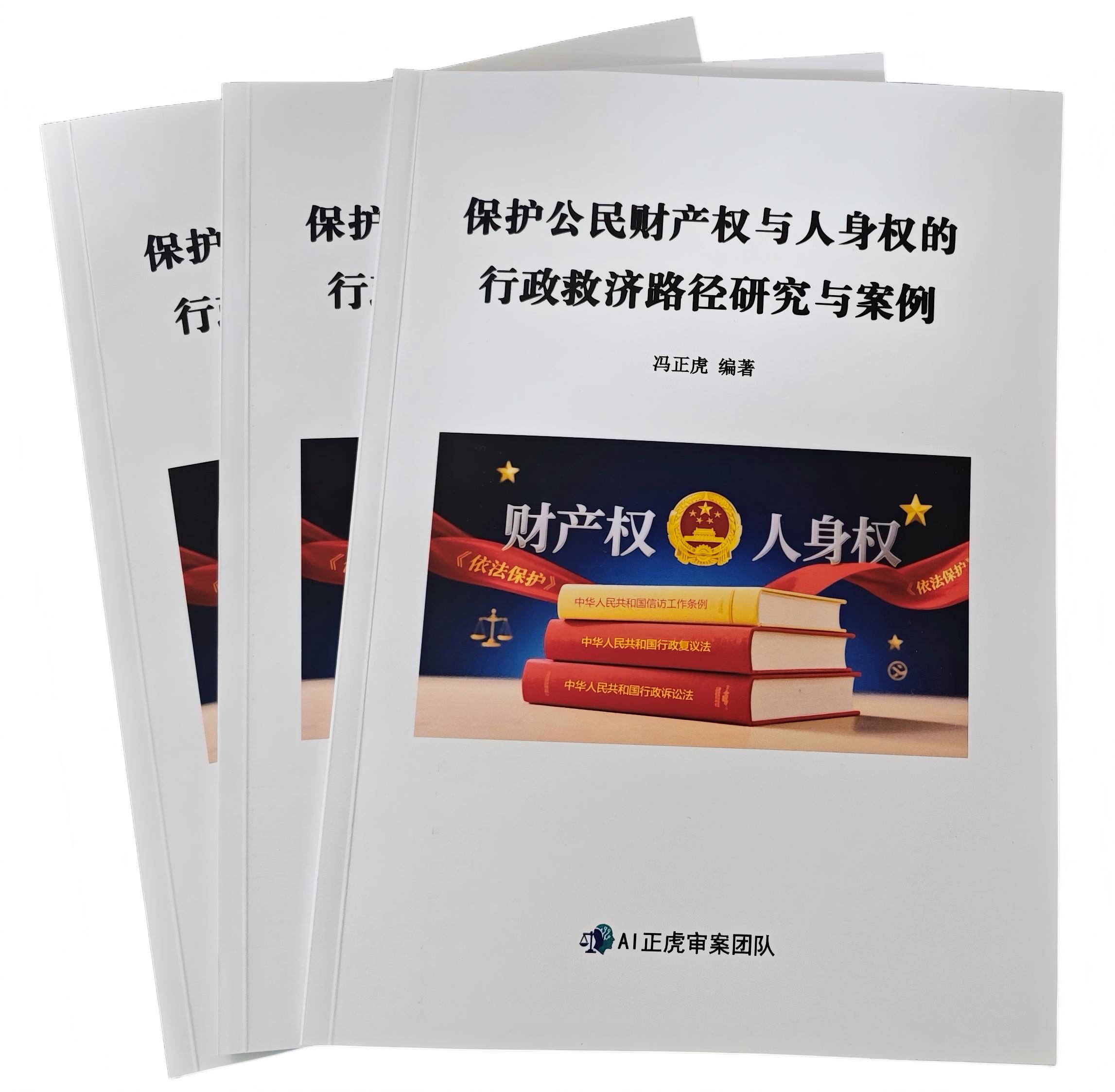
This preface to Feng Zhenghu’s Research and Case Studies on Administrative Remedies for Protecting Citizens’ Property and Personal Rights systematically addresses the practical dilemma faced by Chinese citizens: “administrative inaction and lack of recourse” when safeguarding their property and personal rights. Centered on the newly revised Administrative Reconsideration Law and integrated with the Regulations on Petitioning Work and the Administrative Litigation Law, the author proposes a comprehensive closed-loop remedy system encompassing “duty fulfillment applications, administrative reconsideration, administrative litigation, compulsory enforcement, and accountability.” This aims to bridge the long-standing disconnect between petitioning, reconsideration, and litigation mechanisms. Through case studies, legal analysis, and human-machine collaborative research, this paper not only reconstructs the institutional logic of administrative remedies but also provides ordinary citizens with an actionable and accountable rational path for rights protection. It seeks to advance citizens’ rights from “paper” to “reality.”

In contemporary China, protecting citizens’ property rights and personal rights is both a fundamental principle enshrined in the Constitution and the practical foundation for building a law-based government and achieving lasting social stability. In recent years, with the deepening of law-based administration and judicial system reforms, laws and regulations concerning rights remedies have been continuously improved. The Regulations of the People’s Republic of China on Petition Work, the Administrative Reconsideration Law of the People’s Republic of China, and the Administrative Procedure Law of the People’s Republic of China have been successively revised, providing citizens with multi-tiered remedies from administrative to judicial levels.
However, a persistent and highly contentious practical issue remains unresolved: When administrative agencies fail to respond to citizens’ requests to “fulfill duties protecting property and personal rights” or engage in prolonged evasion and delay, how should citizens safeguard their rights? How should petition departments, administrative reconsideration bodies, and people’s courts coordinate and divide responsibilities? Can the inaction of “failing to perform statutory duties” fall within the scope of cases accepted for reconsideration and litigation? Behind these seemingly technical procedural questions lies the institutional success or failure of whether citizens’ rights can move from paper to reality.
The collection in this book, Research on Administrative Remedies for Protecting the Property and Personal Rights of Chinese Citizens, along with related typical cases and commentary, constitutes a systematic response to this practical dilemma. Centered on the newly revised Administrative Reconsideration Law, with the Regulations on Handling Public Petitions and the Administrative Litigation Law as its two wings, the author pioneers a unified domestic framework that “links” these three statutes into a “three-dimensional” structure. This framework proposes a complete relief cycle of “duty fulfillment application—administrative reconsideration —Administrative Litigation—Enforcement and Accountability“ to establish a complete remedial loop. This aims to institutionally bridge the long-standing disconnect between the ”petitioning—review—litigation“ chain.
The book focuses on systemic reconstruction at the legal theory level. Historically, petitioning, review, and litigation have often been treated in practice as three parallel or even mutually substitutable ”forks in the road.” Some local authorities treat petitions as the “final stop,” dismissing citizens’ rights claims with responses like “under coordination” or “forwarded to relevant departments.” Certain reconsideration bodies and courts habitually categorize citizens’ requests for duty fulfillment as “petition matters” or “internal oversight actions,” refusing to accept them on grounds of “falling outside their jurisdiction.” The result is that the petitioning channel bears the burden of resolving rights disputes that should be addressed through statutory procedures. Administrative and judicial bodies shirk their remedial responsibilities, while citizens become trapped in a prolonged procedural loop, facing a dilemma of “no avenue for appeal, no resolution for claims.”
Addressing this systemic misalignment, this book clearly delineates the functional divisions and procedural connections among the three laws: The Petitioning Work Regulations provide an entry point for expression and case distribution but cannot substitute for statutory remedies; The Administrative Reconsideration Law serves as the primary channel for administrative error correction and rights redress, particularly by establishing the “pre-reconsideration” principle of “failure to perform statutory duties,” thereby subjecting a vast array of inaction to rigid oversight. The Administrative Litigation Law constitutes the final judicial defense, ensuring administrative power operates within the rule of law through legality review and compulsory enforcement. These three are not mutually exclusive options but form a logically progressive, closed-loop system of responsibility.
On the other hand, this book is grounded in vivid and complex domestic Chinese cases. By comprehensively examining two cases—Shanghai Xinzhuang and Pudong—where displaced farmers petitioned the government to fulfill its duties, it concretizes and visualizes abstract institutional designs. Both cases share a common background: land expropriation and demolition issues from the 1990s remained unresolved for years, leading to prolonged disputes over the displaced farmers’ residential land use rights and housing compensation. After repeated petitions and mediations yielded no results, they legally submitted “Applications for Performance of Duties to Protect Property Rights” to the competent administrative authorities under Article 11(11) and Article 23 of the new Administrative Reconsideration Law. Confronted with the reality of “prolonged non-response,” they subsequently initiated administrative reconsideration and administrative litigation procedures.
These cases clearly illustrate a path of exploration from “reliance on petitions” to “lawful rights protection”: the parties no longer content themselves with ‘concern’ and “coordination,” but instead make “fulfillment of statutory duties” their core demand. Through objective evidence such as EMS mailing receipts, case acceptance numbers, and delivery confirmations, they transformed the administrative agency’s inaction from “implicit” to “explicit.” Leveraging the “administrative reconsideration prerequisite” mechanism, they successfully introduced the cases into judicial review procedures. This process should have served as a vivid example of safeguarding citizens’ rights under the new law. Yet, individual cases encountered repeated obstacles at the reconsideration and litigation stages—such as being dismissed as “petition-related,” “falling under internal oversight,” or “outside the scope of acceptance.” This reflects the conceptual barriers and institutional inertia confronting the implementation of the new Administrative Reconsideration Law.
This book goes beyond documenting individual setbacks. Through multiple legal opinions and AI-driven legal analysis, it provides a comprehensive examination of the legal application and factual determinations in relevant reconsideration decisions and court rulings. It meticulously analyzes issues ranging from the application of temporal law and the definition of jurisdictional scope to the boundaries between “internal oversight” and “legality review”; from whether “failure to respond” constitutes inaction subject to reconsideration and litigation, to the mandatory requirement of prior reconsideration in non-performance cases—all receive meticulous and well-reasoned scrutiny. This serves not only as a responsible response to the parties involved in specific cases but also as an institutional reminder to administrative and judicial bodies to accurately understand and implement the new law.
Of particular note is the book’s special attention and humanitarian concern for the “petitioners” group. Those petitioners who “have been circling government offices for a decade without respite” are the direct victims of a failing administrative redress mechanism and the most vulnerable group in need of legal procedures to protect their rights. The book translates complex institutional provisions into accessible “three-step” flowcharts and “rights toolkits” that ordinary people can understand and implement, guiding them from emotional, repetitive petitioning toward rational rights protection grounded in statutory time limits and written evidence. A properly drafted “Application for Performance of Statutory Duties” serves not only as a declaration of one’s rights but also as the “trigger” to initiate legally binding procedures.
In this sense, this book is not merely an academic contribution to administrative law but a practical guide for real-world action. Through in-depth analysis of typical cases involving administrative inaction, judicial inaction, and mutual buck-passing between administrative and judicial bodies, it proposes a set of actionable institutional repair solutions.
At the administrative stage, it reduces room for delay by clarifying the boundary between petitions and duty fulfillment applications, establishing the principle of “no characterization as petitioning,” and mandating time-limit warnings and written responses.
At the reconsideration stage, it leverages “pre-reconsideration” and “time-bound fulfillment decisions” to compel higher-level authorities to conduct substantive reviews and correct inaction by lower-level agencies.
At the judicial stage, a comprehensive accountability framework for inaction is established through enforcement measures including compulsory execution, daily fines, credit sanctions, and referral for criminal liability.
This end-to-end accountability-driven procedural design aims to elevate past “initiative-based” rights protection to a “rigid, accountable mechanism.”
The writing and publication of this book rely on deep collaboration between artificial intelligence technology and human legal experts. The AI Case Review Team leveraged the computational power of large models to conduct structured analysis of vast volumes of regulations, precedents, and judicial documents, thereby identifying common issues and critical junctures in system operation. Concurrently, the authors, drawing on years of practical experience and a commitment to the rule of law, screened, calibrated, and evaluated the value of technology-generated analyses. This ensured rigorous logic while maintaining empathy for the specific circumstances of those involved. This “human-machine collaboration” approach itself represents a valuable exploration of future judicial and administrative decision-making models.
We hope this collection not only provides ordinary citizens long trapped in rights protection dilemmas with a clear path forward, but also offers administrative agencies, petition departments, reconsideration bodies, and people’s courts at all levels a reference framework for institutional design. This framework can assist them in resolving issues concerning jurisdictional boundaries, procedural coordination, and accountability. We further hope it will spark serious discussions among academia, practitioners, and the public on “how to ensure rights are truly realized.”
The new Administrative Reconsideration Law provides more comprehensive institutional tools for protecting citizens’ property and personal rights. The mission of this book is to help people learn how to properly use these tools and to push relevant institutions to genuinely respect and implement these systems. It aims to become an “institutional anchor” for promoting law-based administration, strengthening the foundation of reconsideration, and ensuring effective judicial action, leaving a clear and solid footnote on China’s path toward comprehensive rule of law.
Feng Zhenghu
December 5, 2025, in Shanghai